Showing posts with label Hamlet History. Show all posts

Friday, August 7, 2020

Heirlooms: Little Mementos of Our Ancestors


I've been reading a book for my personal summer reading program called "Gratitude: Affirming One Another Through Stories." By Len Froyen. 2013. I was inspired to compile a list of heirlooms we have by a couple of sentences in a chapter: "Gratitude inspires one generations contributions to the next." and "Gratitude preserves the indispensable heritage of each generation."

Reminds me of my favorite Bible verse found in Proverbs 24:3,4 

By wisdom a house is built, and through understanding it is established; through knowledge its rooms are filled with rare and beautiful treasures." 

Both of us have a wealth of cards, letters, newspaper clippings, photos and recipes that have been shared with us and they are scattered throughout this blog. Be sure to come back to see this list as it is sure to grow longer, for when we sat down to compile a list of our treasures, things that we had forgotten about kept coming to mind. Why just today, my husband dug down in a cabinet to retrieve something of his dad's! smile! 

Here are some of HIS heirlooms:


Ishmael Rush's Bolo Tie clasp he purchased while  on vacation to South Dakota. 


Ishmael Rush's Cuff Links. 

Marie Rush's Red Willow Plate. It hung in her farmhouse kitchen for years and she gave it to me when she learned I loved the novel "Blue Willow" by Doris Gates.  Both Marie and I shared a love of reading. 📚

Norman Rush's toy car. 


Norman Rush's candlestick that he made in high school shop class. It is dated 1950. 


Bertha Carrender's cookie jar. 

And here are some of HER heirlooms:

Tacy Ullom's graniteware cup. Tacy cooked in her husband's inn before and after marriage in Coffeyville, Kansas and in Streator, Illinois before moving out to Postle in the panhandle of Oklahoma to settle.

Gladys O'Neal's print of the Good Shepherd given to her by her Sunday School class. It is from a painting by Warner E. Sallman.


Gladys O'Neal also had a framed copy of this print which was hanging in one of her bedrooms. She gave it to our son. It is called "The Pilot." Also by Warner E. Sallman. 


Gladys Esther (White) O'Neal worked on her genealogy for 28 years, finally publishing it in 1983. Each one of her children and grandchildren received a copy. There are no more copies and Vera Lane holds the copyright. 


Gladys O'Neal had a little ceramic shop out in her garage. Many of the ceramic pieces was used in the wedding cakes she made for the young couples in the area and as VBS crafts. She took some china painting classes and this is one of the plates she painted. I always thought this plate was lovely, so it came to me upon her death as she had a little note taped to the back of the plate that I was to have it.  

Beautiful Girlhood by Mabel Hale.

Gladys O'Neal received this book for Christmas from her parents, Papa and Mama White when she was a girl. 

Russell Griffith's book "The Little Brown Suitcase" is at the bottom of this post. 

Maurine Ullom's Household Searchlight cookbook that she traded a chicken for.


Maurine Ullom's lamp. It was moved from Maurine and John's 2 story old farmhouse to their new ranch house that John had built in the 1960s on their Postle, Oklahoma farm.


Maurine Ullom's Dutch couple. 

Maurine Ullom's small crockery pitcher. She had a love for dolls and miniatures and she used it for toothpicks. 

We visited Hallie Maple at her 2-story home up in Stanberry, MO several times where she gave me all of her genealogy notes for the Bailey and Morris families and gave me this old doll. She made the dress herself as it was to grace her made bed as a bed doll.  According to the internet, classic boudoir dolls were meant for decoration rather than play and was popular during the 1920s to 1940s. 

Robert O'Neal's 2 year old summer suit he wore for a photo along with long hose that went up over his knees and high top, tie-on oxford shoes. Imagine wrestling a squirmy kid in and out of this outfit. 😁

Little Robert, when about two or three years old, played with these little dolls. As worn as the paint is on the female doll, I'd say his three siblings played with them too! 😄

Lavon Robertson purchased a pair of these lamps as a gift for her mother. They sat on the vanity in the guest bedroom for many years.

Melba Robertson gave Lavon this perfume bottle which sat on her dresser until Lavon's passing. 


Mom's repainted porch glider.

Article written and updated by : Dolores J. Rush. 

Friday, June 12, 2020

We're Pet People

I listed five pets that brought me joy over the years in my positivity journal, including our most recent pet - Lily, a tan chihuahua dog, who died in April during coronavirus lockdown. When I first joined Find-a-grave, occasionally I ran into pet memorials (yes, Find-a-grave allows them) and at the time, I thought it silly to have them on there, but I've changed my mind since then as making a memorial for Lily brought me some measure of comfort after she passed. 

She joined our family in 2009 after a trip to Tennessee to visit family for Thanksgiving and we brought her home with us. Since she was a rescue dog, her guesstimated age was about 10 months old at that time. She was very afraid of the car and rode on my shoulder the whole way home in panic mode, but since that time, she loved to go riding as her daddy spoiled her by buying a treat (hotdog) for her at Quik-trip when he stopped to buy gas and a coke. She also went with us on many weekender vacation trips and was a good rider. 

I've been spring cleaning and finding things of Lily's. Some I've packed away, in case we decide to add a new pet to our household in the future, but holding them in my hands makes me miss her. She balanced out the females to the males in our home and we had her for ten years. As her Find-a-grave memorial states, I taught her many things for she was a smart dog and good company. I mentioned her in this article about genealogy code here

Today, I remembered that I had some documents concerning her shots, etc. packed away in a filing cabinet. So I dug them out and thought that they might be good documents to prove our residence at the time as they have our address written on them.  However, since this is a sample, I've taken care to remove our address from the below record for this article. 


Here's a list of other pets that I remember. I have a few more records in my filing cabinet for other pets like Ami, Baby, and Hunter. I remember a few more critters that our family kept as pets, but will have to dig for their names to add to this list. 


  1. Ami (D. Rush; female Bichon Frise dog)
  2. Baby Cakes (D. Rush;  male bicolor cat)
  3. Blackie (J. Ullom's male farm dog; they thought he was a mutt, but he looked like a black Irish Setter)
  4. Bumbles (S. Yoder; cat)
  5. Candy (J. Ullom's rat terrier)
  6. Darby (P. Eubank; male dog)
  7. Darcy (D. Rush; male Sheltie dog)
  8. "Don't remember name" pets (finches, fish, gerbils, hamsters, a hermit crab, a horned toad, lizards, turtles)
  9. Diamond (I.L. Rush; horse) 
  10. Freckles (N. Rush's male Brittany Spaniel dog)
  11.  Ginger (N. O'Neal; female Lhasa Apso dog)
  12. Gracie (M. Rush; Great Danes)
  13.  Hunter (D. Rush; Pomeranian)
  14. King (M. Rush; Great Dane)
  15. Lily (D. Rush; chihuahua)
  16. Misty (D. Rush; pet rabbit) 
  17. Nancy (J. Ullom; Shetland pony)
  18. Nellie (I.L. Rush; horse)
  19. Nova (S. Yoder; cat)
  20.  Perry (D. Rush; parakeet)
  21.  Pretty Boy (N. O'Neal; canary)
  22.  Rusty (R. O'Neal; Irish setter)
  23.  Sam (N. O'Neal; Beagle dog)
  24. Shirley (I.L. Rush; horse)
  25. Snowflake (I.L. Rush; horse)
  26. Song (N. O'Neal; female Siamese cat)
  27. Sugar (I.L. Rush; horse)
  28. Sugar (R. Rush; female miniature poodle)
  29. Tippy (I.L. Rush; dog)
  30. Violet (S. Yoder; cat)


Saturday, February 29, 2020

Positive Memories - Trails

As Weekend Ramblers, my husband and I have visited these trails a time or two and compiled the list we have been on for my positivity journal this month. They are shown in my corresponding YouTube video here at time 1:40. How many have you traveled on? When we homeschooled, we would take a field trip on the weekends to find and read historical markers as enrichment material. You can find many of them listed on this website.  My husband and I joined the KCAHTA last year to learn more about the Historic Trails in our area. 

Boone's Lick Trail -- if you wish to read more about Daniel Boone, click here. 

Butterfield Overland Mail Route 

Denver-Canadian-Dallas highway - read about Postle, Oklahoma, a tiny town on this early road

California Trail

Lewis and Clark - you may read about George Sibley, who was in charge of Fort Osage on the Missouri River. 

Military Road from Ft. Leavenworth to Ft. Scott, Kansas

Oregon Trail

Pony Express Route - you may wish to read about Alexander Majors. 

Santa Fe Trail or National Frontier Trails Center

Trail of Death 

Trail of Tears 

My husband collects tack pins and patches from each of the trails he and I have touched down on as a memento of the experience.  This first batch of pins is from the Lewis & Clark Trail. The second are from (left to right) Santa Fe Trail, the Oregon Trail, the California Trail, the Mormon Trail, the Trail of Tears, the Continental Divide Trail and the Grizzly Trail.  The patches are from the Lewis & Clark Trail and the rest are from various other trails. 


Monday, August 20, 2018

Avoid the Pitfalls of Sloppy Work


If you want your work as a family historian to be taken seriously, then avoid the pitfalls of Sloppy Work (F-) 
like the plague.
I know compiling your family tree is a work in progress, however, 
you must think logically and use some of those skills you learned in school! 
Everything you do in life, whether it is employment or a hobby, 
has its own protocol and vocabulary.

"through the rules we become conscious of wrongdoing." 
~ Romans 3:20.


To begin, gather your supplies. It is GOOD (A+) to have supplies and tools to work with. Go shopping if you must. Sign up for a library card at your local library or genealogy center and obtain copies of their pre-printed charts and forms or print your own! Purchase a file box for copies of printed records and photos. It's good to have access to a basic set of an encyclopedia. As you graduate from elementary research to intermediate and expert, you can add to your tool-bag as needed. 

FIRST DAY OF SCHOOL =  Begin your genealogical education with a tutor or by reading everything you can lay your hands on about genealogy. Just like professional teachers take refresher courses from time to time, be sure to update your knowledge base from time to time as well. This includes watching videos.  For extra credit, join a genealogical society or attend a genealogical conference. If you don't know something, keep asking questions or google it until you get your answers. 


ARITHMETIC = It's good to use a timeline for each person's life - start with what you already know and begin with their birth-date, adding in each fact during their life-time, up until their death. Figure out their approximate age at each added date. Recording dates and calculating ages is a helpful tool for logically figuring out if that's your ancestor in an outside record. 

WRITING = It's good  to add dates and locations to all facts in each person's life-stream.

You get an A+ if you pair the names of the locations with their component part -- indicate whether it is a city, township, or county! [i.e.. Kansas City, Washington Township (Twp.), Jackson County (Co.), State of Missouri (MO.), United States of America (USA)]

It's good to add parentheses around a married woman's maiden name. [i.e. Gladys Esther (White) O'Neal]


Here's a tip = type in the source of your record when you scan your book page to upload to genealogy sites. Then you will never forget where you found it, because it will be meshed into your digital picture! 

SOCIAL STUDIES = It's good to add in additional national or regional historical event facts to their timeline that occurred during their life. I leave my ancestor's information in black and add in additional information in another color. 


It's good to remember in the New World what kind of roads (none to Indian trails) and transportation were available to our American ancestors - ships on oceans, walking, horses, boats on rivers, wagons, trains, horseless carriages, airplanes and rockets in that order. Twenty miles of travel by wagon was a good day! It took many months of twenty mile days to cross the North American continent from coast to coast. 


SCIENCE = Good traveling was mostly done between the late spring and early fall seasons. By fall, the grass had grown tall and the water sources would have been lower or dried up. 


There was safety in numbers for our pioneer ancestors. Migrating people groups had to contend with hostile natives, illnesses, lack of healthy food, clean water, thieves, and the terrain. Military forts, doctors, and trading posts were few and far between if they existed on the frontier.  It's good to find FAN's (friends, associates, and neighbors) of your relatives as their descendants may have additional information about them. 

READING = It's good to find at least three sources of data per date to prove your relative's parents, their name, birth, death and anything in between. Many of the "Documents of" type posts on this website shows the type of records I have collected and transcribed. The more I find, the better I will get to know my ancestors and their families. 

New information is good! And it is also good to remember to note that on your person's timeline at that moment! Otherwise you may forget!

SPELLING = It's good when you spell names correctly.  However, remember, that not all people spell well, so look for all possible variations when scouting for information.

It's good to know that your ancestor may have a name twin!  My husband has six in our Metro Area. Using your timeline (s), figure out if the newest record jives with what you already know about your person as far as their dates, locations, their age and so forth. If it doesn't line up, discard it or set it aside for the time being until you know more. I don't accept every leaf hint that shows up for my ancestor on Ancestry.com.  


And please, be mindful of your manners! (A +) 

Now GO And Have Fun! 

Tuesday, July 18, 2017

Treasured Memories

Jesus, sing along with me, "Precious Memories, how they linger . . ."

Jesus, do you remember where you slept when you were a boy and later as a man? Can you picture it in your mind, remember all the details of that place?  The sights, the sounds, the smells, the feel of your blankets and lumps where you lay? 

I went to my grandmother's last night as I lay in my bed at home, nestled under a quilt grandma Maurine made for my high school graduation.
My inner eye and I roamed around in my grandmother's basement where we slept as kids during our summer break from school (we sometimes stayed a month during our three month break) and during our Christmas break (two weeks) and then upstairs in her second bedroom when I was sixteen. Do you remember that Jesus? I felt so grown up as I was allowed to visit my grandparents by myself and to travel to Dodge City, Kansas by train where they picked me up. Thank you for being with me, protecting me along the way. My mother never said anything, but I'm sure she was anxious until I made it there and they assured her I was okay when we called her from their house. I was excited and homesick all at the same time.
I miss grandma and Papa. Jesus, do you remember when I called him that? He was Papa until I think I was in high school and felt I was too old for such a childish name for him. I miss being able to visit them, but last night, I pushed past my emotions and looked around the rooms in my memory while I lay snugly under my quilt.
Will you come along with me as I remember grandma's basement? It was a wide open space, except for where the stairs came down into the third end of the room.  Grandma had grandpa build a little storage room under the stairs and shelves on the left side of the stair wall for her pretties. She would rotate them as she got tired of looking at them or when the seasons or holidays changed. On the right side of the stairs there were the white metal cupboards they removed from the kitchen in the old house before it was sold and moved into town.

Grandma told me they began housekeeping in a 2-room house, which was still standing the last time I was down at the farm, then they purchased a two story house in Elkhart, Kansas and moved it to their farm in the 1940s. On the plains of the Oklahoma panhandle and southwestern Kansas where wood for building was scarce, my mom said it was a common practice to remove whole buildings to a new site. After 20 years of living in that house, Grandpa decided to have a 2-bedroom ranch house built over a basement in 1962-63, thinking it would be easier for Grandma to keep house. 

Do you remember Jesus, that Grandma loved that old house as much I did? I don't know why she loved it, but I did because it was full of interesting nooks and crannies. It had a lot of character. 

As I lay in bed, I swept my mind's eye around the room, feeling cozy and loved under my quilt. Beside me a few feet away, was Grandpa's office desk and chair. We kids loved that chair, do you remember why Jesus? We loved to sit in that wooden arts and crafts chair and spin each other just for the fun of it until mom would yell down the stairs and chase us out-of-doors to play. On the left side of Grandpa's desk was a bookcase where he kept his farm books mostly. After awhile, Grandpa brought home a huge metal safe to keep their photos and accounting books in. It was on the wall on the right side of the desk.

Remember the old living room furniture Grandma brought over from the old house – her scratchy old beige sofa, a braided area rug, an old blanket trunk, an old wooden kitchen chair with the black vinyl covered seat that wasn't fastened down and a end table arranged in a circle? In the corner, sat her old round oak dining room table. I loved that hefty pedestal table on huge claw feet and rollers as it could be pushed out from the wall a little if needed so all of us kids could crowd around (there was four of us and usually two or more cousins) to play games on it. Often times, when it was rainy or a blizzard blew in, we would play "house" down there. It was cool down there in the summer and warm in the winter. 

Then there was the three double iron beds that we each slept in. One was mom's squeaky bed from when she was a girl. My sisters usually claimed that one, but my brother refused to sleep with me after he said I kicked him out of bed several times in a row in my sleep. Jesus, knowing my brother, he was probably being onery to me and I kicked him out in self-defense, but since I was asleep, I don't remember it. Jesus, did you have any pesky little brothers? 

I remember the way the basement smelled, dusty. None of the basement walls or the floor were painted or sealed, so when we left, Grandma would cover the beds with plastic sheeting because that fine Oklahoma dirt would sift in through the basement windows, two on each wall whenever a storm would stir up.

Jesus, I felt so grown up as I lay in the upstairs bed in between the crisp white sheets where my parents usually slept when we came down during the Christmas holidays. Dad would take his two-week vacation time then and we would drive to our grandparents, usually during the night so that we kids slept on the way down in the back of the station wagon that mom and dad made up into a bed. Two at the top of the mattress and two at the bottom, with our legs and stocking feet meeting somewhere in the middle under the quilt. Sometimes I would just lay there, looking up at your beautiful night sky as the car rolled down the highway (eight hours one way). The sky didn't change much, but lower down, the telephone poles would flash by, one after the other. Thank you, Jesus, for that conjunction of Mars and Jupiter. There was much speculation that this was the star the wise men saw that year. Thank you for that precious memory.

Jesus, remember that new oak bedroom set that Grandma purchased in town when she moved into the new house for the second bedroom? The double bed was stationed under an aluminum drapery-framed window. Instead of opening from the bottom as our windows at home did, these slid open from the side. They were a wonder. My grandparents had air-conditioning, but sometimes they would shut it off during the night and open the windows to let in the fresh night-time breezes through the screen. Their air was dry, not humid like where we lived. The windows were shut before the heat of the day began. 

The walls were painted white and the trim around the windows and doors were stained oak to match the bedroom furniture. Opposite the bed on the right side, was another window that looked toward the back of the house where the cement patio was. I always wanted a covered concrete patio like theirs. Their back door was constantly in use, unlike the formal front door.  Thank you, Jesus, for providing a home for my family with a small covered concrete porch.

Across the room, at the end of the bed, was the clothes closet and the exit door to the hallway. There was a beige carpet on the floor that led out to the hallway. And, facing me, as I curled up in the bed, was the oak bureau with mirror. As a good hostess, grandma kept two drawers empty so visitors would have some place to stash their stuff and a closet full of hangers. I can remember waking up at the crack of dawn and watching the sun come up, sometimes falling back to sleep until I heard my grandparents stirring in their bedroom. Once, grandpa, laughing, came to shake me awake. I guess I was talking in my sleep about horses! Jesus, the things I did in my sleep! I was rather embarrassed! LOL! Jesus, did you do anything funny in your sleep?

Jesus, I want to tell you  thank you for allowing me to have a relationship with my grandparents. Many of my friend's grandparents lived too far away or some had died before they were born, so they didn't know what they were missing. Grandma Maurine and I were close like this (holding two fingers up side by side); she was my best bud and a kindred spirit. All through my growing up years we corresponded by letter throughout the year.

Do you remember, Jesus, when my grandparents asked you to come into their hearts, to wash them whiter than snow? I bet your angels were rejoicing in heaven the day they did. 

Grandma Maurine met Papa at a camp-meeting in Topeka, KS. I don't recall how my paternal grandmother met my grandfather, but they were married in a pastor's home before Sunday School began. I expect that's why I'm a believer today, because they influenced my parents and thus me to follow Christ.

Remember Timothy, Jesus? He had a godly grandmother too. It says so in 2 Timothy 1:5 --

"I have been reminded of your sincere faith, which first lived in your grandmother Lois and in your mother Eunice and, I am persuaded, now lives in you also."

Paul told him to guard the good deposit, all the good reading from the scriptures he received from his grandmother and his mother, from infancy up, and Paul's discipleship in evangelism.

I thank you Jesus, for the treasured memories of my grandparents. See you in heaven, Grandma Maurine and Papa John. Until then. . .

More to Read:
Findagrave, # 15079870 and 15079845

Wednesday, November 25, 2015

Miller County Historical Society Museum


Anyone with an interest in the history of Miller County (org. 1837) in central Missouri or in the pioneers who lived here ought to visit the Miller County Historical Society’s Museum. It is located next to the new courthouse in Tuscumbia.
The Miller County Historical Society began in 1979, with the museum opening in 1980 in the jail adjacent to the old County Courthouse. It moved, in 1991, to the former Anchor Milling native stone building as their exhibits expanded. The museum has recently been remodeled and a new wing added on for a genealogy library. Two historic log cabins have been moved to the grounds next to the museum and Nancy Thompson joined the museum as director.
They love donations of materials from the history of Miller County like objects and pictures for exhibits, and genealogy scrapbooks for the library. They have added many books, records such as probate, marriage, and obituaries and set up computers for online research too. Much of the county’s historical information has been made available on their website as well. Exhibits include the Civil War, quilts, the Osage River port and steamship history, Lee Mace and the Ozark Opry, an old country store, an old-fashioned schoolroom, and so forth.
The museum is run by volunteers and depends solely upon fund raisers, donations, and the society’s membership fees to run the museum. My husband is a life-time member. The cost of touring the museum is FREE.
Call, write, or see their website for current schedule and other information.
Miller County Historical Society Museum, PO Box 57, 2005 Hwy 52, Tuscumbia, MO 65082, 573-369-3500
-------------------------------------------------------------------------------------------------------------
 Have you ever considered using calling cards or business cards to document your ancestor?
I was rummaging through some old business cards I had and found two that I can say with certainty fall into the historical document list as these people are no longer in the leadership role these cards portray. 


You are seeing correctly! I removed the personal telephone information from these two business cards, but all the other information for the Historical Society Museum is correct.
Dr. Harold Joe Pryor (1943-2021) 

~~ <> @ <> ~~

You might be interested in reading other posts that mention the Miller County Missouri museum:


Written by Dolores J. Rush. Updated: 7/24/2021. 

Saturday, October 17, 2015

The Dalton's Raid on the Banks in Coffeyville, Kansas

Map of Coffeyville, Kansas
October 5, 1892
--------------------------------------------------------------------------------------------------
Yellow marks the spot where the Ullom Restaurant (Walnut St.) and
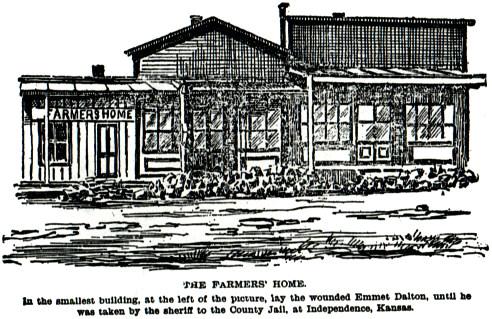
Farmer's Home (115 West 8th St.) were located. 
To enlarge, click on photo and zoom screen until you can see the map clearly.
--------------------------------------------------------------------------------------------------
The Daltons Are Dead!

They Have Made Their Last Raid – Bob, Emmet and Grat All Bite the Dust.
----------
AND OTHER LIVES GO, TOO.
----------
A Daring Attempt to Rob the Banks at Coffeyville, Kas, Results in the Loss of Ten Lives.
----------
Intense Excitement as the News Goes Broadcast.
----------
DEAD:
Bob Dalton, desperado.
Grat Dalton, desperado.
Tom Heddy, desperado.
Joe Mingo, desperado,
C.T. Connelly, marshal of Coffeyville.
George Cubine, merchant.
Charles Brown, shoemaker.

FATALLY WOUNDED.
Emmett Dalton, desperado.
Thomas G. Ayers, cashier First Nat. bank.
Lucius Baldwin, clerk in Brown’s shoe store.

SLIGHTLY WOUNDED.
T. Reynolds, citizen.
Louis Dietz, citizen.
----------
The Dalton band of outlaws, the most notorious in the West, was wiped off the face of the earth at Coffeyville, Kansas, yesterday, but in the battle which resulted in their extermination three good citizens were killed and two fatally wounded.

The desperadoes, who had grown bolder as they thought that they were above all law and that the officers of the country were powerless against them, had attempted to raid, the banks of this their old home when they met the fate which they so well merited, but which they had heretofore escaped. Had they confined their efforts to train robbery they might now be alive, but emulation of the James boys proved their deaths. This was their first attempt at bank robbery and their last piece of outlawry.

BOLD RAID ON THE BANKS.

The six outlaws rode into Coffeyville together on horseback about 9:30 o’clock and leaving their horses in an alley, walked rapidly across the square and four entered Condon’s banks and two the First National.

At Condon’s bank the desperadoes were told by Cashier Ball that the time lock would not be open until 10 o’clock, so holding their Winchesters on Ball and Teller Charles Carpenter, said they would wait, taking meanwhile, the money in the drawer.

Bob and Emmett Dalton were the two who took in the First National. Here were Cashier Ayers, his son Bert and Teller W. II. Shepherd. They were forced to give all the money in the safe which was hastily shoved into bags.

The Daltons then forced the three out of the front door and followed right after them.

CITIZENS AND OUTLAWS BATTLE.

The alarm had in the meantime been given and as the outlaws appeared George Cubine, a merchant, and Express Agent Cox shot at one of them, badly wounding him. The outlaws then returned the fire, killing Cubine.

The robbers in Condon & Co., bank shot out of the window, hitting Ayers and Brown.

Both robbers ran back through the bank when they were met by Baldwin and fatally wounded him.

The citizens being thoroughly aroused by this time, were after them hot and heavy and after a fight in which City Marshall Connelly was killed succeeded in killing the four desperadoes named and mortally wounded Emmet.

A LIVERY MAN’S DEADLY AIM.

Jim Spears, a livery stable keeper, with Winchester rifle, killed three of the outlaws in as many seconds. This created such a diversion that other citizens were enabled to get close enough to kill another one of the robbers.

The two remaining robbers dropped their plunder and mounted their horses, but a posse was quickly in pursuit and one more of the bandit gang fell from his horse mortally wounded about two miles from town. The sixth and last was still being pursued at latest accounts.

The man who got away is supposed to be Allie Ogee.

All of the money was recovered to a cent and turned over to the banks.

EMMETT DALTON CONFESSES.

Emmet Dalton has made a partial confession that his gang was the same that robbed the Pacific express car on the Missouri, Kansas & Texas railroad at Adair station in the Indian Territory last July and committed other daring robberies.
--------------------------------------------------------------------------------------------------
The Coffeyville Journal
(Coffeyville, KS, Elliott Printing Co, Friday, October 7, 1892)

Column 2, Paragraph 1, Line 50, Page 2 – Emmett Dalton was removed to Dr. Well's office and dressed.

Col. 7, Paragraph 1, Page 2 – Sheriff Callahan made preparations to remove Emmett Dalton to the jail at Independence this morning, but was compelled to abandon the attempt on account of the manifest disposition of the people to resist anything of the kind. It is safe to say that Dalton would have been taken away from the sheriff and hung, if the sheriff had taken him out of the room where he is confined at the Farmer's Hotel.


Col. 7, Paragraph 3, Page 2 – It was the intention of the Daltons to leave their horses at the hitch rack north of Ullm's restaurant and in front of McCoy's, but they found the street in that locality all torn up and piles of rocks stacked about and the hitching posts gone. They were compelled to change their plans at the last moment. They would have had ten chances in one in escaping from the city had their first plan not been interfered with. They dropped into a place where our people had them at a decided disadvantage.

------------------------------------------------------------------------------------------------
The Dalton Brothers and Their Astounding Career of Crime. By an Eyewitness. (Chicago, Laird & Lee, 1892; reprinted by New York, Jingle-Bob, 1977).
p. 142 -- The landlord of the queer little hostlery, the sketch of which is to be found in this little volume and which was called by the rather ambitious name of the Farmer's Home, told his friends, since the destruction of the Dalton gang set his tongue free-that, more than once, had he been awakened, in the dead of night by Bob knocking at his window, he had been forced, on those occasions, to admit the robber chief and those of his men that were with him. The landlady had been called upon to prepare a warm supper for the "gentlemen of the highway." and to accept their thanks--instead of their money. At the time, the terror those precocious bandits inspired was such that there was no thought of refusing them anything or any imprudent talking, the next day, over the incident.
p. 197 - Emmett Dalton passed this first night in continuous pain. Amputation of his arm was suggested, but he would not consent. At noon of the next day, he was removed to the Farmer's Home, the little frame boarding-house the Dalton brothers used to patronize on their nightly excursions and there he lay in the front room of the smaller building, for the next five days, exposed to the gaze of hundreds.

--------------------------------------------------------------------------------------------------
Coffeyville Journal, July 28, 1928, p. 1, Col. 6. --
ULLOM FUNERAL AT 2 P.M. TOMORROW
-------------
Rites for Pioneer Hotel Man Will be Conducted at Skinner's -- Burial in Elmwood.
------------
The body of Alford Ullom, 81 years old, pioneer hotel operator of Coffeyville, who died at his farm home near Elkhart, Kan., Thursday, arrived here this afternoon and was taken to the Skinner funeral home to lie in state until the funeral hour tomorrow.
Funeral services will be held in the chapel of the Skinner funeral home tomorrow afternoon at 2 o'clock, conducted by Rev. O.P.Garlock, pastor of the United Brethren church. Burial will be in Elmwood cemetery by the side of his first wife, Mrs. Samantha J. Ullom, who died here in 1891.
*****
Died July 26, 1928
Buried at Elmwood Cemetary, Coffeyville, KS.
Block 19, Lot 1, Plot 7.
--------------------------------------------------------------------------------------------------
The Farmer's Home on 8th Street.

(Note: Building farthest to your left.)
 --------------------------------------------------------------------------------------------------
Coffeyville Journal, Saturday, July 28, 1928 --

BERT ULLOM MAKES FIRST VISIT SINCE HE LEFT HERE IN 1892

Bert Ullom, Indianapolis bricklayer here to attend the funeral of his father, Alford Ullom, who died Thursday at his home near Elkhart, Kan., this morning grew reminiscent of early days in Coffeyville, which he left with his parents in 1892. He had not seen the town since until he arrived here yesterday.

Ullom's father, who will be buried tomorrow afternoon at 2, kept the old Farmers' Home hotel, which stood at the corner of Eighth and Walnut streets, on the site now occupied by the Florae drug store.

Ullom, who was a youth of twenty years when the Dalton raid took place, remembers distinctly incidents that occurred in Coffeyville on that day, and this morning stated that Emmett Dalton, the youngest member of the marauding band, after he was shot from his horse as he prepared to leave town when all of his comrades had been slain, was carried to the office of Dr. Walter H. Wells, over the old Slosson drug store.

After the youth's wounds were dressed, according to Ullom, Emmett was removed from Dr. Wells' office to what was then known as the Upham building, standing on the site of the present Traction building. Emmett never was taken to the Farmers' Home, Ullom declared.

Ullom, who lived with his parents in the Farmer's Home, heard shots in the street that memorable day, and, fired with boyish curiosity, tore excitedly out into the street. Grat Dalton had just come out of the Condon National Bank, and young Ullom stopped not ten feet from the outlaw and saw the Daltons shoot down two shoemakers, Brown and Cubine, who had appeared across the street.

After the battle had ended by the deaths of the gangsters, the mother of the Dalton boys came to Coffeyville and put up at the Farmers Home, while she saw three of her sons buried and one sent to the state prison.

Ullom came here last night for the funeral of his father and plans to return to Indianapolis tomorrow night. He grew to manhood in this city, and was a boyhood friend to Mayor Harry Lang, on whom he called this morning.

Mr. Ullom, who formerly operated the old Farmers Home hotel here at Eighth and Walnut Streets, left here with his family in January, 1892, and after living a time at Streator, IL., moved to Elkhart, where he lived until his death Thursday.

He is survived by his second wife, Mrs. Tacy Ullom, formerly Miss Tacy Berry of Coffeyville, and thirteen children. There are six children by his first wife; Mrs. Linna Karstedt of Indianapolis, Mrs. Hannah Warner of Chicago, Mrs. J. H. Nixon of Chicago, Bert Ullom of Indianapolis, Clarence Ullom of Los Angeles and James Ullom of Houston. The seven children by his second wife are Mrs. Mabel Griffith, Miss Laura Ullom, Frank Ullom, Lawrence Ullom, Ronald Ullom, John Ullom, all of Elkhart, and E. C. Ullom of Streator, IL. Practically all of the relatives will be here for the funeral.

The deceased was born May 12, 1847, in Wetzel County, W.Va. He came to Coffeyville with his family about 1878, and operated hotels at different locations here until 1892.

A sister of his second wife, Mrs. Fay Clark, lives at 1512 Walnut street.
--------------------------------------------------------------------------------------------------
Clarence Ullom Remembers, March 21, 1929 --

CAFE MAN WAS SCHOOL MATE OF EMMETT DALTON
------

Conversation concerning "tough hombres" and "bad men" in the Shultz and Holder Barber Shop the other morning prompted CL Ullom, proprietor of the Golden Rule Coffee Shop to relate his personal reminiscences of the Dalton brothers who terrorized Southeastern Kansas and the Osage country adjoining in the early 90's.

Mr. Ullom went to school with Emmet Dalton, the youngest of the gang and knew the other boys personally, he said. He was in Coffeyville when the gang was wiped out following an attempted bank robbery. Emmet, his old school mate who was 19 years old on the day of the affray, was shot down in the streets of Coffeyville with 24 buck shot in his back. He was taken into the office of Mr. Ullom's father, who died but recently on his Texas County farm east of Elkhart, and given medical treatment. Upon hearing that a mob was on its way to get him for hanging, young Dalton asked for a gun and asked everyone to clear out and let him meet the mob. He was taken to the penitentiary from Coffeyville, Mr. Ullom said.
--------------------------------------------------------------------------------------------------
The Old Timers As I Remember Them. By Chester C. Tucker. c.1963.

ULLUM CAFÉ = was run by a brother of John and Ronald Ullum. He called it the Golden Rule Café. It was located in the Muney building.
---------------------------------------------------------------------------------------------------
When the Daltons Rode
By Emmett Dalton in collaboration with Jack Jungmeyer.
(Garden City, NY, Doubleday, 1931)

p. 234 – We were . . . acquainted with all the prominent merchants and with every law officer of the town of Coffeyville.

p. 262 – After the Coffeyville battle I was carried to a vacant room above Slausson's Drugstore. There I lay on a long bare table the rest of that day and night. It was thought I should die of my many and serious wounds. The following afternoon I was removed to a room in the little hotel where I lay five days more.

p. 263 – In the hotel room I was under the watch of a single guard most of the time.

p. 264 – With ghoulish curiosity the visitors thronged the streets. They gaped up at the window of my hotel room.

--------------------------------------------------------------------------------------------------

Coffeyville Journal, Tues. October 19, 1937 --

MRS. TACY ULLOM DIES AT ELKHART
------------
Widow of Early-day Farmer's Hotel Proprietor in Coffeyville Succumbed Yesterday.
------------
Mrs. Tacy E. Ullom, 69, widow of Alfred Ullom, proprietor of the Farmer's hotel here before leaving Coffeyville forty-two years ago, died yesterday at Elkhart, Kan. She had been in failing health six years, and had been confined to bed part-time since suffering a hip injury in a fall last January. She was born July 30, 1868, in Washington.

The Farmer's hotel was at the intersection of the alley at the 100 block on West Eighth street, the present location of the Traction building. Emmett Dalton, wounded in the raid on the banks here in 1892, remained at the Farmer's hotel while convalescing, early-day residents recalled today.

Mrs. Ullom is survived by two daughters, Mrs. Mable Griffith and Miss Laura B. Ullom, both of Elkhart: six sons, Ellsworth of Streator, Ill. and Lawrence, Ronald, Frank, John and Clarence of Elkhart; one sister, Mrs. Fay Clark, 1512 Walnut street, Coffeyville; and one brother, Levett Berry of Warner, Okla.

The body will be removed here tomorrow. Funeral services, in charge of the Rev. James E. Ivy, pastor of the First Church of God will be held at 2:30 o'clock Thursday afternoon at the Skinner funeral home. Burial will be in Elmwood cemetery, beside the remains of Mr. Ullom, who died nine years ago.
*****
Died: October 18, 1937
Buried at Elmwood Cemetery, Coffeyville, Kansas
Block 19, Lot 1, Plot
---------------------------------------------------------------------------------------------------------
Emmett Dalton lying in his room in the Farmer's Home.

---------------------------------------------------------------------------------------------------------
The Dalton Gang.
By Harold Preece
(New York, Signet Books, 1963.)
pp. 130-131 – Kansas living on the border of turbulent Oklahoma had became as fearful as their forebears who had been compelled to put up with Missouri as a neighbor. But the Daltons also had friends and tickbirds in the Jayhawker state, including men who did business with Brother Bill and a certain Coffeyville innkeeper who was always ready to extend them hospitality in stealthy post-midnight visits.
p. 163 – Later, when prices had accumulated on their heads, making post-midnight visits to a hotel called the Farmer's Rest, where the frightened -- or, maybe, friendly -- proprietor always scraped them up a meal.
pp. 189-190 – On the next morning, Emmett was moved to the Farmers' Home Hotel.
p. 197 – Only on October 8, three days after the robbery, did Ransom Payne arrive to play his bit part in the Dalton drama. He called on Emmett, sick and shot up, at the Farmer's Rest Hotel.
p. 210 – No authentic history of the Daltons could be written during his [Emmett's] lifetime; invariably he threatened to sue the author. No magazine article could be published unless it featured his distorted interpretations, make the brothers look like lightly transgressing angels. He was constantly on the lookout for authors who would do the Dalton story according to Emmett. 
---------------------------------------------------------------------------------------------------------
Outlaws on Horseback.
By Harry Sinclair Drago
(New York; Dodd, Mead, & Co., 1964).

p. 229 -- the bloodiest fifteen minutes in the annuals of Western outlawry. Four citizens killed; four wounded among the defenders. On the other side of the ledger, Bob and Grat Dalton, Dick Broadwell and Bill Powers were dead, Emmett lying helpless in the Farmers' Home, a small inn on Eighth Street, to which he had been removed after the battle by Sheriff Callahan and placed under guards.

---------------------------------------------------------------------------------------------------------
By Our Calculations, at the time of the Raid:
Clarence Ullom, 1st son of Alford & Samantha Pitman Ullom (d. 1891) was 22 yrs.
Bert, 20 yrs.
Jim, 18 yrs.
Hannah, 13 yrs.
Lina, 11 yrs.
Ollie, 7 yrs.
Alford & 2nd wife: Miss Tacy Berry, were married September 22, 1892, approximately 12 days before the raid by a Methodist minister.
---------------------------------------------------------------------------------------------------------
Centennial of the Dalton Raid on the Banks, 1892-1992 
Coffeyville, Montgomery Co, Kansas


The young man is Alford Ullom's 2nd great-grandson with his daddy. 
-----------------------------------------------------------------------------------------
More to Read:
1. Alford Ullom Biography
2. History of the Daltons in Belton, MO.
3. The Dalton Defenders Museum
4. Emmett Dalton website
5. Emmett Dalton's Findagrave Memorial #3568
6. Dalton Gang Photograph (small boy's face peering through the fence is Ray H. Clark).
7. Dick Broadwell's Re-burial 
8. History of Montgomery County, Kansas. Published by Lew Wallace Duncan. Press of Iola Register, Iola, KS;  p. 33-41. Google Books
9. Wikipedia article on the Daltons

Researched by Dolores J. Rush. Updated: 10/6/2019.